
01CarbonBlaze explainer
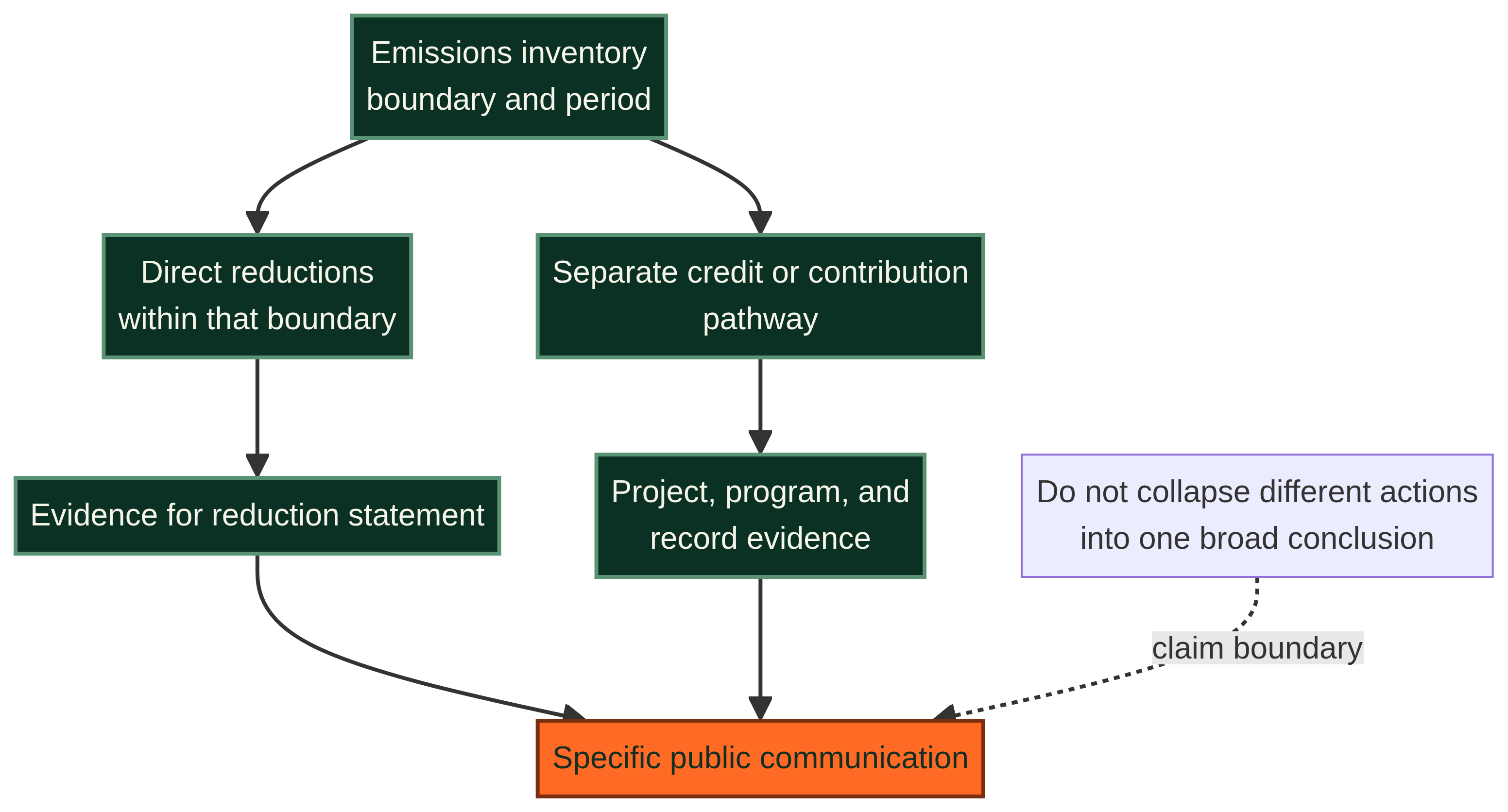
A good claim makes its boundary clear.
Start by describing what is being discussed: an organizational inventory, a product, a project, a target, a direct reduction, or credit use. Ambiguous terms can make very different actions appear interchangeable.
02CarbonBlaze explainer
Keep direct reduction and credit use separate.
Readers should be able to identify what emissions were measured, what actions reduced them within a stated boundary, and how any carbon credits were used. Each element deserves its own evidence.
03CarbonBlaze explainer
Language should match evidence and avoid overreach.
If a statement is broad, the underlying scope, time period, methodology, and supporting materials should be easy to locate. When uncertainty exists, it should be acknowledged rather than hidden.
↗Related field paths
Follow the connected evidence questions.
These local guides explore adjacent parts of the same evidence trail. They are starting points for learning, not project ratings or recommendations.
Guide 47 · Four documents, different questions
Reading carbon-offset records
A source-led way to separate activity estimates, crediting rules, project evidence, registry status, and public communication without turning any single record into a verdict.
Open guideGuide 13 · Follow the unit
The carbon-credit lifecycle
How project design, methodology, review, issuance, tracking, transfer, retirement, and public records fit together without any one step becoming a complete quality verdict.
Open guideGuide 05 · Follow the record
How carbon registries work
Learn what a registry can show about issuance, ownership, transfer, retirement, and the public record behind a unit.
Open guideCommon questions
What should a climate claim include?
At minimum, clear scope and time context, the activity or outcome being described, and a route to supporting information are helpful starting points.
Can an organization say it is Net Zero because it purchased credits?
Net Zero terminology is governed by specific frameworks and is not established solely by the purchase of credits. A reader should examine the organization’s inventory, reduction pathway, target framework, and claim language.