
01CarbonBlaze explainer
Registries help create an identifiable record.
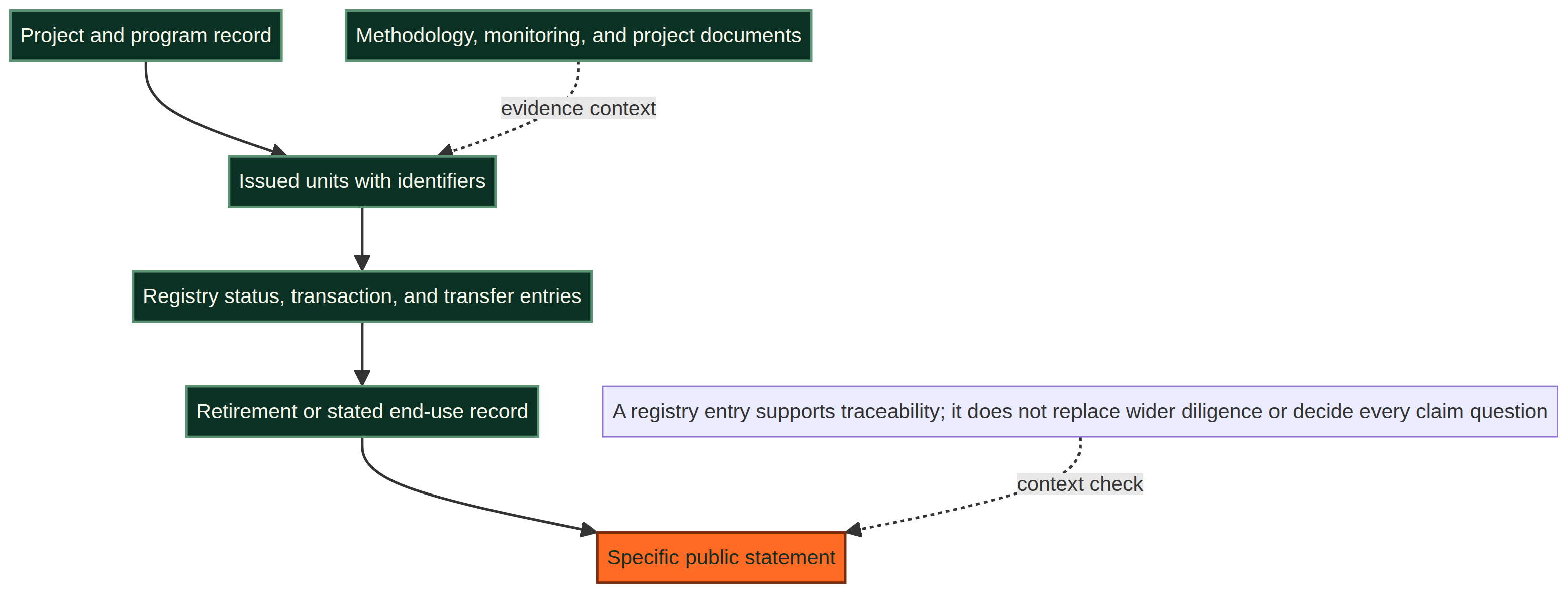
A registry can assign a unique identity to a project and to issued units, then record transactions and retirement. This creates an evidence trail that helps prevent confusion about which credits exist and how they have been used.
02CarbonBlaze explainer
A registry record is one important layer of diligence.
A public record can help readers locate project documents, issuance information, and retirement details. It does not replace understanding the assumptions, methodology, or context used to quantify an outcome.
03CarbonBlaze explainer
Traceability supports clearer claims.
When a public claim involves credit use, being able to identify the relevant credit, registry, and retirement record makes the claim easier for others to understand and scrutinize.
↗Related field paths
Follow the connected evidence questions.
These local guides explore adjacent parts of the same evidence trail. They are starting points for learning, not project ratings or recommendations.
Guide 47 · Four documents, different questions
Reading carbon-offset records
A source-led way to separate activity estimates, crediting rules, project evidence, registry status, and public communication without turning any single record into a verdict.
Open guideGuide 13 · Follow the unit
The carbon-credit lifecycle
How project design, methodology, review, issuance, tracking, transfer, retirement, and public records fit together without any one step becoming a complete quality verdict.
Open guideGuide 06 · Say what happened
Making clearer carbon claims
A practical guide to separating emissions inventories, direct reductions, target setting, credit use, and public-facing climate language.
Open guideGuide 37 · Engineered removal context
Direct air capture
An original guide to atmospheric CO₂ capture systems, energy sources, storage pathways, measurement, and lifecycle questions.
Open guideCommon questions
What does retirement mean?
Retirement typically records that a unit has been removed from circulation for a stated use, so it should not be transferred or claimed again within that registry system.
Do all registries work identically?
No. Readers should review the relevant program rules, public interfaces, documentation, and project-level information.